UTRECHT, Netherlands — October 1, 2026
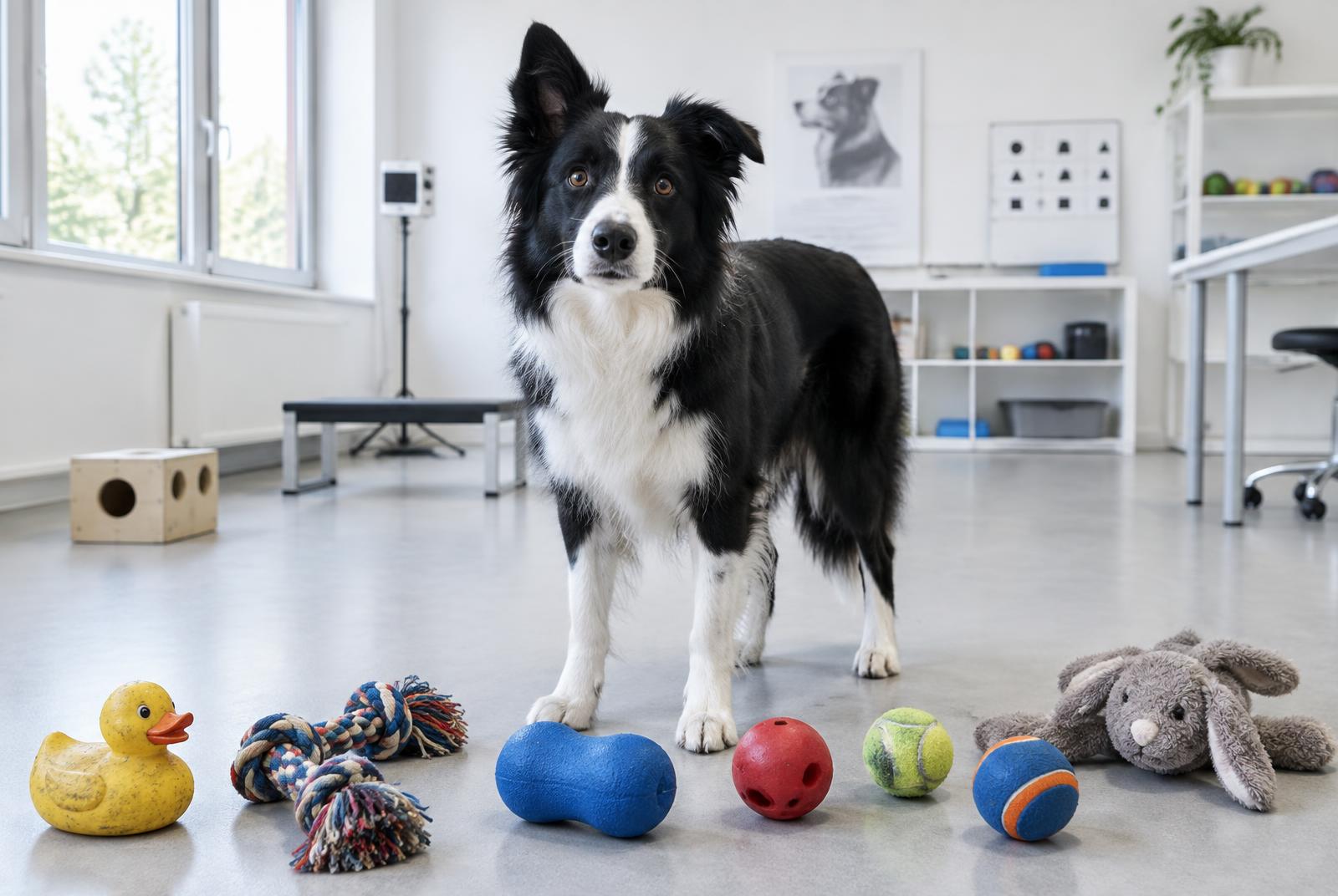
At 8:17 on a quiet Tuesday morning, Atlas walked into a white testing room at the European Canine Cognition Centre carrying a faded yellow rubber duck in his mouth.
Nobody had asked him to bring it.
The researchers laughed, took the toy from him and placed it beside 11 other objects scattered across the floor: a rope, a stuffed rabbit, a plastic ring, two balls, a wooden block and several toys Atlas had never seen before.
Behind a one-way glass panel, cognitive scientist Dr. Elise van der Meer watched as Atlas's owner, 31-year-old software engineer Clara Hoffmann, received an instruction through an earpiece.
"Ask him for the dax."
There was no object called a "dax" in Atlas's vocabulary.
Eleven of the twelve objects in front of him, however, had names he already knew.
"Dax," Hoffmann said. "Atlas, bring the dax."
The black-and-white border collie stood still for several seconds.
He looked across the room.
Then he walked past the familiar toys, stopped beside a small blue foam object he had never encountered before and picked it up.
It was the correct answer.
Atlas repeated variations of the experiment 17 times that morning.
He succeeded 15 times.
According to the research team that has studied him for nearly three years, it was one of several experiments that persuaded them that Atlas possesses an extraordinarily unusual combination of memory, vocabulary, inference and problem-solving ability.
This week, following an eight-month independent testing program involving researchers from four European canine cognition laboratories, Atlas was formally recognized by the fictional International Canine Cognition Project as the highest-performing dog yet examined under its standardized intelligence battery.
In less scientific language, Atlas had just been crowned the smartest dog in the world.
"He isn't simply very obedient," van der Meer said. "That's the first distinction people need to understand. Obedience and cognition are not the same thing. Atlas appears to build representations of objects, categories and relationships between words in a way that we see in only a very small number of dogs."
An accidental discovery
Atlas was born on March 11, 2020, on a working sheep farm outside Bremen, Germany.
He was the fourth puppy in a litter of seven.
There was nothing particularly extraordinary about his early life. His breeder described him as energetic, intensely observant and somewhat difficult to tire out.
Hoffmann bought him when he was ten weeks old.
She had originally wanted a running companion.
Instead, she got a dog that appeared unusually interested in human speech.
The first clue came when Atlas was approximately five months old.
Hoffmann had given names to several of his toys — "bear," "rope," "ball" and "duck" — without deliberately training him to memorize them.
One evening, she casually told him to find his duck.
Atlas disappeared into another room and returned carrying it.
Hoffmann assumed it was coincidence.
She tried again.
"Bear."
Atlas returned with the bear.
Within several weeks, Hoffmann began writing the names of his toys in a notebook.
Twenty-seven became 50.
Fifty became 100.
By Atlas's second birthday, Hoffmann had documented more than 300 objects that he appeared able to retrieve by name.
She contacted researchers.
Most were skeptical.
That reaction was understandable.
Claims about exceptionally intelligent animals are notoriously difficult to evaluate. Owners can unintentionally signal answers through their posture, gaze or tone of voice — a phenomenon known as the Clever Hans effect, named after a famous horse in early 20th-century Germany whose supposed mathematical abilities were ultimately traced to subtle human cues.
Researchers therefore began separating Atlas from Hoffmann during testing.
Objects were placed by experimenters he had never met.
In some trials, Hoffmann did not know where the correct object was located.
In others, instructions came through speakers.
Atlas continued performing.
"That was when it became interesting," van der Meer said.
1,463 known objects
As of September 2026, Atlas has demonstrated reliable recognition of 1,463 individual object names, according to the laboratory's current database.
That figure is not based simply on Hoffmann's claims.
For an object to enter Atlas's official vocabulary, researchers require him to correctly retrieve it during repeated randomized trials conducted on different days.
Some objects are ordinary.
Ball.
Duck.
Hammer.
Sock.
Panda.
Others have names invented by Hoffmann when Atlas was younger: "Momo," "Flip," "Zuki," "Nappo."
Researchers say Atlas does not appear to care whether a word has meaning to humans. What matters is whether the sound consistently refers to a particular object.
More remarkable is what happens when those objects disappear.
In one long-term memory test, researchers removed 40 toys from Atlas's environment for six months.
When the objects were returned and mixed with unfamiliar toys, Atlas correctly retrieved 37 of them by name on his first attempt.
"He remembered objects he had not seen or heard mentioned for approximately half a year," said Dr. Jonas Eriksen, a comparative psychologist who participated in the independent evaluation.
"That's the sort of result where you repeat the experiment because you don't immediately trust what you're seeing."
He understands categories, too
Atlas's abilities appear to extend beyond memorizing names.
Researchers taught him that a collection of different spherical objects could collectively be called "balls."
They then presented him with balls made from unfamiliar materials, in unfamiliar colors and sizes.
Atlas classified most of them correctly.
The same occurred with several other categories, including ropes, plush toys and rings.
In another experiment, he learned two verbal instructions:
"same."
And:
"different."
Researchers would show him an object, then place two objects several meters away. One shared a particular characteristic with the original — shape, texture or material — while the other did not.
Atlas learned to select according to the requested relationship.
His success rate varies depending on the task, and scientists caution strongly against interpreting his abilities as equivalent to human language.
Atlas does not speak, construct sentences or demonstrate anything resembling a human understanding of grammar.
But his performance suggests something researchers find almost as interesting: he appears capable of learning abstract rules rather than merely memorizing individual commands.
The test that surprised everyone
The most discussed experiment occurred in May.
Researchers showed Atlas a new toy for approximately three minutes.
It was called "Kimo."
Atlas played with it briefly before researchers removed it.
He did not see the object again for 28 days.
During that time, nobody was permitted to use the word Kimo around him.
Four weeks later, researchers placed Kimo among nine unfamiliar objects.
Hoffmann watched through a video feed from another room.
An automated speaker gave the instruction.
"Atlas. Find Kimo."
Atlas searched for 11 seconds before selecting the correct object.
The laboratory repeated similar delayed-memory experiments with several objects.
His performance was not perfect.
But it was substantially above chance.
"He makes mistakes," Eriksen emphasized. "That's actually important. If somebody showed me a dog getting 100 percent of everything correct, I would immediately become suspicious."
A normal dog at home
For all the scientific attention surrounding him, Atlas spends most of his life doing things that are considerably less impressive.
He steals socks.
He dislikes vacuum cleaners.
He sleeps beside Hoffmann's kitchen table.
He has a habit of staring at people who are eating cheese.
His favorite food is boiled chicken, and his favorite possession is reportedly not one of the hundreds of toys in his research collection but an old orange tennis ball with most of its felt missing.
Atlas weighs 21.8 kilograms and stands approximately 55 centimeters at the shoulder.
He has predominantly black fur, a white chest, white front legs and a narrow white stripe running between his eyes.
His left ear usually stands upright. His right folds slightly forward.
Hoffmann says strangers often expect Atlas to behave like some kind of canine genius.
"They'll meet him and immediately start testing him," she said. "They'll ask him questions like, 'What's two plus two?' And I'm like, he's a dog. He doesn't know mathematics."
His extraordinary performance also comes with less convenient characteristics.
Atlas requires several hours of physical and mental activity every day.
If he becomes bored, Hoffmann says, he creates his own entertainment.
Once, while left alone for approximately 40 minutes, he opened a kitchen cabinet, removed a box containing dog treats and carried it upstairs.
He was apparently unable to open the box itself.
"So he brought me the entire box," Hoffmann said.
Can a dog really be called 'the smartest'?
Scientists are cautious about the title.
Animal intelligence is notoriously difficult to compress into a single measurement.
A dog that excels at vocabulary may perform poorly in another domain. Working dogs may possess extraordinary spatial awareness. Livestock guardian dogs can make independent decisions with very little human instruction. Detection dogs can identify odors at concentrations humans can barely conceptualize.
"There isn't one universal thing called intelligence," van der Meer said.
Calling Atlas the world's most intelligent dog is therefore partly shorthand.
What researchers can say is more specific.
Among dogs examined using the project's standardized battery, Atlas currently holds the highest combined score across object-name learning, long-term memory, novel-word inference, categorization and multi-step problem solving.
He performed especially well in vocabulary and memory.
He was less exceptional in one social reasoning experiment involving hidden food and human pointing gestures.
Two Labrador retrievers actually outperformed him.
"Atlas is not the best dog at everything," van der Meer said. "That would make the story less believable scientifically, because cognition doesn't really work that way."
Why border collies keep appearing
Atlas's breed is not entirely surprising.
Border collies were developed over generations to work closely with humans while controlling livestock across large distances.
The job demands attention, sensitivity to gestures, rapid learning and the ability to respond to combinations of verbal commands and whistles.
Several of the most famous dogs studied for exceptional word learning have also been border collies.
Researchers believe genetics probably contributes to Atlas's abilities.
But environment matters too.
Hoffmann has spoken to him continuously since puppyhood, and Atlas lives surrounded by named objects.
His daily routine resembles an accidental language-enrichment program.
At around 7 a.m., he walks for approximately five kilometers.
Later in the morning, Hoffmann usually conducts a 15- to 20-minute toy session.
Formal research sessions are deliberately kept short.
Scientists stop testing if Atlas appears tired, distracted or unwilling to participate.
Food rewards are used in some tasks, although researchers say Atlas frequently appears more motivated by getting access to the requested toy itself.
What comes next
The research team is now interested in a harder question.
Can Atlas learn relationships between words?
Researchers have begun preliminary experiments involving combinations such as object names and location instructions.
Instead of simply hearing "panda," for example, Atlas might hear:
"Put panda in basket."
Or:
"Bring rope to Clara."
The goal is to determine whether he treats the individual words as independent pieces of information or memorizes each complete instruction as a single command.
Scientists are also sequencing Atlas's genome as part of a larger study involving exceptionally fast-learning dogs.
Nobody expects to find a single "intelligence gene."
Researchers instead hope that comparing dogs like Atlas with hundreds of ordinary dogs could eventually reveal combinations of genetic traits associated with attention, working memory and sensitivity to human communication.
Atlas, meanwhile, appears indifferent to his new title.
After completing his final testing session in Utrecht last month, researchers removed the cameras and opened the laboratory door.
Atlas walked directly past the scientists who had spent months measuring his cognitive abilities.
He crossed the hallway.
Stopped beside a canvas bag.
And began staring at it.
Inside was his battered orange tennis ball.
Hoffmann laughed.
"He always knows where that thing is," she said.
For perhaps the smartest dog on Earth, there were apparently more important things to think about.